Home EV Charging vs. Public Charging: Which Is Cheaper in 2026?
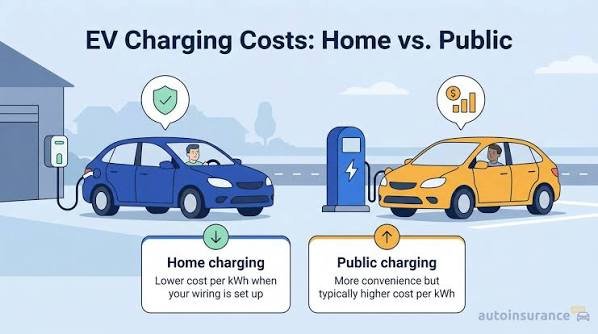
Electric vehicles can save drivers money on fuel and maintenance, but how much you actually save depends on where you charge your car. Some EV owners plug in at home overnight, while others rely on public charging stations at shopping centers, workplaces, highways, and dedicated charging hubs.
At first glance, home charging seems like the obvious winner because residential electricity is often cheaper than public charging. However, the real cost difference depends on local electricity rates, the type of charger you use, your driving habits, and whether you need to install charging equipment at home.
In 2026, these factors matter more than ever as EV charging networks expand, public charging providers introduce different pricing plans, and utilities offer time-of-use electricity rates in some areas.
So, is charging an electric vehicle at home really cheaper than using public charging stations? In most cases, yes. But public charging can still make sense for apartment residents, drivers without dedicated parking, and people who frequently travel long distances.
This guide compares home EV charging with public charging, explains the costs involved, provides real-world examples, and helps you choose the most affordable charging strategy for your needs.
Home EV Charging vs. Public Charging: What’s the Difference?
Before comparing costs, it helps to understand how the two charging options work.
What Is Home EV Charging?
Home EV charging means charging your vehicle at your house, apartment, or another private parking location where you have access to a suitable electrical supply.
There are two common options:
- Level 1 charging: Uses a standard household outlet where supported. It requires little additional equipment but charges relatively slowly.
- Level 2 charging: Uses a dedicated higher-power AC charging circuit and compatible charging equipment. It is significantly faster and is generally more convenient for regular home charging.
Home charging lets you plug in whenever your vehicle is parked. Many drivers charge overnight or schedule charging during cheaper electricity periods.
If you already have suitable electrical wiring and a convenient outlet, your initial costs may be relatively low. Installing a dedicated Level 2 charger, however, adds equipment and installation expenses.
What Is Public EV Charging?
Public EV charging involves using charging stations available outside your home. These stations may be located at:
- Shopping centers and supermarkets.
- Public parking garages and municipal lots.
- Highways and travel plazas.
- Hotels and restaurants.
- Offices and workplaces.
- Dedicated EV charging hubs.
Public chargers generally fall into two broad categories.
Public Level 2 chargers provide AC electricity and are useful when your car will be parked for an extended period, such as during work or shopping.
DC fast chargers supply direct current to the vehicle’s battery and can charge compatible EVs much faster. They are particularly useful for road trips or situations where you need to add a substantial amount of range quickly.
Public charging prices vary by network, location, charging speed, membership plan, and sometimes the time of day.
Home EV Charging vs. Public Charging: Cost Comparison
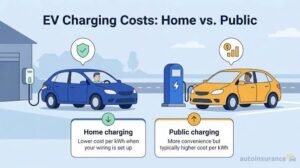
The biggest difference is usually the price of electricity. Residential electricity often costs less per kilowatt-hour (kWh) than public DC fast charging.
However, electricity rates vary considerably across the United States, and public charging prices can differ even between stations operated by the same network.
Here is an illustrative comparison for 2026.
| Charging option | Example electricity price | Typical use |
|---|---|---|
| Home Level 1 | $0.15–$0.25/kWh | Overnight charging with modest daily driving |
| Home Level 2 | $0.15–$0.25/kWh | Everyday charging at home |
| Public Level 2 | $0.20–$0.40/kWh | Charging while parked at work or shopping |
| Public DC fast charging | $0.40–$0.70+/kWh | Road trips and quick charging stops |
These are illustrative U.S. planning ranges, not verified nationwide averages or guaranteed 2026 prices. Your actual cost may be lower or higher depending on your utility, location, charging provider, and membership status.
The important point is that you should compare the price you actually pay per kWh rather than assuming every public charger or home electricity plan has the same rate.
For drivers who can charge at home using ordinary residential electricity rates, home charging is usually the least expensive option.
How Much Can You Save by Charging at Home?
To understand the difference, let’s use a simple example based on an electric car that consumes 3,600 kWh of charging energy per year.
Assume a home electricity rate of $0.1844 per kWh and a public charging rate of $0.418 per kWh. These figures are based on 2026 U.S. residential electricity data and AAA’s public charging price average as of October 13, 2026. Actual rates vary by location and charging provider. <Cite refs={[“turn682523search6″,”turn682523search2”]}/>
| Cost comparison | Home charging | Public charging |
|---|---|---|
| Price per kWh | $0.1844 | $0.418 |
| Annual energy use | 3,600 kWh | 3,600 kWh |
| Annual charging cost | $663.84 | $1,504.80 |
| Monthly average | $55.32 | $125.40 |
In this example, home charging saves approximately $841 per year, or about $70 per month, compared with paying the public charging rate for all your energy.
These estimates exclude home charger installation, membership fees, parking charges, and any additional fees. They also assume the same amount of energy is purchased under each option.
For drivers who charge regularly, that difference can add up over several years.
How Much Does It Cost to Install a Home EV Charger?
One important consideration is the upfront cost of setting up home charging.
If you already have a suitable electrical outlet, you may be able to begin with Level 1 charging without installing a dedicated charging station, provided your vehicle’s charging equipment and the outlet are appropriate for the intended use.
For faster charging, a Level 2 charger is generally more practical.
Typical U.S. planning estimates include:
- Level 2 charger hardware: Approximately $300–$900 for many residential models.
- Standard installation: Approximately $500–$1,500, depending on the property and electrical work.
- More complicated installation: $2,000 or more if extensive wiring, a long cable run, panel work, or other upgrades are required.
These are broad estimates, not guaranteed 2026 quotes. Get a local electrician to assess your property before budgeting for installation.
Is Installing a Home Charger Worth the Cost?
Let’s say your charger and installation cost $1,500, and charging at home saves you approximately $841 annually compared with public charging.
Your simple payback period would be:
$1,500 ÷ $841 = approximately 1.8 years.
After that point, the charging cost difference could continue to work in your favor. However, this calculation excludes financing, maintenance, electricity rate changes, and other costs. Your savings will also be smaller if you use public charging only occasionally.
If you expect to own your EV for several years and drive regularly, a home charger may be a worthwhile investment.
Level 1 vs. Level 2 Home Charging: Which Is Cheaper?
Both options use residential electricity, so the cost per kWh is generally similar. The main difference is charging speed and convenience.
<row gap={3} align=start> <box flex=”1″ gap={2}> <AsyncImage query=”electric car plugged into standard household wall outlet garage level 1 charging cable” aspectRatio=”4:3″ width=”100%”/> Level 1 charging
<text color=”secondary” size=”sm”>Best for light driving</text>
- Low setup cost.
- Uses a suitable standard household outlet.
- Slow charging, often adding only a few miles of range per hour.
- May be enough if you drive short distances daily.
</box> <box flex=”1″ gap={2}> <AsyncImage query=”wall mounted level 2 EV home charging station electric car garage charging cable” aspectRatio=”4:3″ width=”100%”/> Level 2 charging
<text color=”secondary” size=”sm”>Best for regular driving</text>
- Requires a suitable dedicated circuit.
- Charges much faster than Level 1.
- Often restores a substantial amount of range overnight.
- Can support smart charging schedules.
</box> </row>
Level 1 charging may be the cheapest way to get started, but it is not necessarily the best long-term choice. If you drive long distances or need your vehicle ready early each morning, Level 2 charging can make daily use much easier.
Choose a charger that matches your vehicle’s onboard charging capability and your home’s electrical capacity.
Public Level 2 vs. DC Fast Charging: Which Costs Less?
Not all public chargers have the same pricing structure.
Public Level 2 chargers are often found at workplaces, shopping centers, hotels, and parking garages. They are useful when you can leave your vehicle connected for several hours.
DC fast chargers provide much higher charging power and are designed for situations where you need to add range quickly.
Generally, public Level 2 charging can be less expensive than DC fast charging, but the actual price depends on the site. Some Level 2 locations are free for customers, while others charge by the kWh, by the hour, or through parking fees.
DC fast charging typically costs more because it offers faster service and involves more expensive charging infrastructure.
Before plugging in, check the displayed rate and any session, parking, or idle fees. A low advertised energy price may not represent the total cost if additional fees apply.
How to Make Public EV Charging More Affordable
If you cannot charge at home, you can still take steps to reduce your charging expenses.
1. Compare Prices Before You Plug In
Use the charging network’s official app or the station’s pricing display to check the rate before starting a session.
Nearby stations can have different prices, even when they use the same charging network.
2. Look for Workplace Charging
Some employers provide free or discounted EV charging as an employee benefit.
If your workplace offers charging, it may reduce your dependence on more expensive public fast chargers. Check whether the station has time limits or parking fees.
3. Check Membership Plans
Some charging networks offer subscriptions that reduce the per-kWh rate.
A membership makes sense only if the discount exceeds the subscription fee.
For example, if a plan costs $10 per month and saves $0.10 per kWh, you would need to purchase at least 100 kWh monthly at the discounted rate to break even.
Calculate your expected charging volume before subscribing.
4. Use Charging Apps to Find Lower-Cost Stations
Charging apps can help you locate compatible stations, compare available networks, and check pricing information.
Remember that prices and availability may change. Confirm the rate before starting a session.
5. Take Advantage of Free Charging Carefully
Free public charging can reduce your costs, but it may have restrictions, such as limited parking time, slower charging speeds, or a requirement to make a purchase.
Avoid making a special trip solely for free electricity if the travel time and expense outweigh the savings.
Home Charging vs. Public Charging for Apartment Residents
Home charging becomes more complicated when you live in an apartment or condominium.
Even if you have a parking space, you may not have permission or access to install a charger. The building may need electrical upgrades, shared charging infrastructure, or approval from the property owner or association.
If you rent, consider these alternatives:
- Ask the landlord or property manager about installing a charger.
- Look for residential buildings with EV charging facilities.
- Check whether your workplace provides charging.
- Use public Level 2 chargers for longer parking periods.
- Reserve DC fast charging for situations where you need a quick recharge.
- Compare the cost of nearby charging networks before choosing where to charge regularly.
If you depend entirely on public charging, the cost difference between an EV and a gasoline vehicle may be smaller than expected, particularly when you frequently use expensive fast chargers.
That does not automatically make an EV a poor choice. Vehicle efficiency, maintenance, local fuel prices, insurance, and your charging habits all affect the overall cost of ownership.
Does Charging at Home Increase Your Electricity Bill Significantly?
Yes, your household electricity bill will increase because your vehicle uses additional electricity. However, the increase may be lower than what you would otherwise spend on gasoline or public charging.
For example, if your car uses 300 kWh each month and your electricity rate is $0.18 per kWh, the additional energy cost would be:
300 kWh × $0.18 = $54 per month.
Your actual bill may differ because of electricity delivery charges, taxes, time-of-use rates, and other utility fees.
If your utility offers an EV-specific or off-peak rate, charging during the designated lower-cost period may reduce the expense. Check the plan’s eligibility requirements and whether other household electricity use would be billed differently.
Also consider charging losses: the electricity drawn from the wall is generally somewhat higher than the energy ultimately stored in the battery. Your monthly usage should reflect the energy billed by your utility, rather than only the battery’s rated capacity.
Is Home Charging Better for the Environment?
Both home and public charging can support lower-emission transportation. The environmental impact depends primarily on the electricity source, vehicle efficiency, and how the charging infrastructure is powered.
Home charging can make it easier to use rooftop solar panels or schedule charging when renewable electricity is more available. Some utilities and smart charging systems offer programs that help shift electricity use to favorable periods.
Public charging stations may also use renewable electricity or participate in energy management programs, depending on the provider.
Neither charging method is automatically emission-free. If you want to reduce the environmental impact of your EV, consider your local electricity mix, the availability of renewable energy, and your vehicle’s energy consumption.
Common Mistakes to Avoid When Comparing Charging Costs
Before deciding which option is cheaper, avoid these common mistakes:
- Comparing different electricity amounts: Compare costs for the same amount of energy delivered to your vehicle.
- Ignoring installation costs: Home charging requires an upfront investment if you need new equipment or wiring.
- Assuming every public charger has the same price: Rates vary by location, network, charging speed, and membership.
- Forgetting subscription fees: A discounted charging rate may not save money if you rarely use the network.
- Ignoring parking and idle fees: These can increase the total cost of a public charging session.
- Overlooking utility tariffs: A home EV rate may be cheaper than your standard residential rate, but the full tariff terms matter.
- Choosing a charger that is too slow: A low-cost charger may not meet your daily driving needs.
- Assuming public charging is always expensive: Free workplace charging, discounted public stations, and favorable membership plans can change the calculation.
The best comparison uses your actual home electricity rate, the prices of the public stations you regularly visit, and your expected annual driving distance.
Home EV Charging vs. Public Charging: Which Should You Choose?
The right option depends on where you park, how often you drive, and how quickly you need to recharge.
| Your situation | Best starting point |
|---|---|
| You own a home with a garage or driveway | Home Level 2 charging |
| You drive short distances each day | Consider Level 1 charging if it meets your needs |
| You live in an apartment without a charger | Public Level 2 or workplace charging |
| You regularly take long road trips | Home charging for daily use, DC fast charging on trips |
| You have access to free workplace charging | Use it when practical and permitted |
| Your utility offers inexpensive overnight electricity | Scheduled home charging |
| You cannot install a charger | Compare public charging rates and consider a charging membership |
For most EV owners with suitable parking and electrical access, home charging offers the best balance of cost and convenience. Public charging remains essential for road trips and a practical alternative for drivers who cannot install a charger.
Final Thoughts
Home EV charging is generally cheaper than public charging in 2026, especially when you can use ordinary residential electricity or a favorable off-peak tariff. Public DC fast charging usually costs more per kWh, but it provides the speed and flexibility needed for long journeys and drivers without home charging access.
The financial advantage of charging at home can be substantial. In our example, a driver using 3,600 kWh annually would spend about $664 at the illustrative home rate, compared with approximately $1,505 at the public charging average used in the calculation. Actual costs will vary with local rates, vehicle efficiency, and charging habits.
However, the full picture includes the cost of installing a home charger, possible electrical upgrades, public charging subscriptions, and access to workplace or residential charging.
If you can charge at home regularly, consider installing a suitable Level 2 charger and using scheduled charging to take advantage of lower electricity rates. If home charging is not available, compare public networks carefully and use lower-cost Level 2 or workplace charging when possible.
Ultimately, the cheapest EV charging strategy is the one that combines affordable electricity, convenient access, and equipment that matches your everyday driving needs.
Pricing reference: U.S. Energy Information Administration electricity data and AAA public EV charging prices. Rates are location-specific and may change; check your utility and charging provider for current prices. <Cite refs={[“turn682523search6″,”turn682523search2”]}/>