Home Solar Battery Storage: How to Save Energy for Nighttime Use
Introduction
Solar energy has become an increasingly popular choice for homeowners looking to reduce electricity bills and adopt a more sustainable lifestyle. Solar panels can generate electricity from sunlight during the day, powering household appliances and other electrical devices. However, one common challenge remains: solar panels produce little to no electricity at night, when many families are still using lights, televisions, refrigerators, and other appliances.
This is where home solar battery storage becomes especially useful. By storing excess electricity generated during the day, a solar battery allows homeowners to use that energy in the evening or during periods when sunlight is unavailable. Instead of relying entirely on electricity from the grid after sunset, households can make greater use of the energy their solar panels produce.
Modern home battery systems are becoming more advanced, offering features such as intelligent energy management, backup power, and integration with smart home technology. Although installing a battery requires an initial investment, the potential benefits include greater energy independence, better use of solar power, and protection against certain electricity price increases.
Understanding how home solar battery storage works can help homeowners decide whether it is the right investment for their property. From choosing the correct battery size to understanding installation costs and long-term savings, several important factors should be considered before making a decision.
What Is Home Solar Battery Storage?
Home solar battery storage is a system that stores electricity for later use. It is commonly installed alongside rooftop solar panels, allowing homeowners to save some of the electricity generated during sunny periods and use it when their panels are producing less energy.
Without a battery, excess solar electricity is often exported to the electricity grid, depending on the system configuration and local utility arrangements. Homeowners may receive a credit or payment for this exported electricity, but the value varies by location and electricity provider.
A battery offers another option: storing some of that excess electricity for use later.
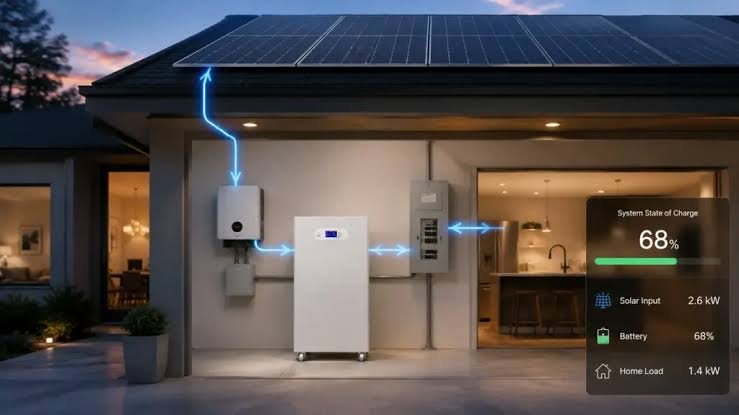
For example, a household may generate more electricity than it needs at midday. Rather than exporting all the surplus energy, the system can use it to charge a battery. In the evening, when the sun has set and household electricity demand increases, the stored energy can power selected appliances or supply a substantial portion of the home’s electricity needs.
A typical home solar battery system includes:
- Solar panels: Generate electricity from sunlight.
- Battery: Stores electricity for later use.
- Inverter: Converts electricity between the forms required by solar panels, batteries, and household appliances.
- Energy management system: Coordinates charging, discharging, and household electricity use.
- Electrical protection equipment: Helps ensure the system operates safely.
The exact equipment depends on whether the battery is installed with a new solar system or added to an existing one.
How Does Solar Battery Storage Work at Night?
<AsyncImage query=”home rooftop solar panels residential wall mounted home battery storage inverter installation” aspectRatio=”16:9″ width=”100%”/>
The basic idea behind solar battery storage is simple: generate electricity when sunlight is available, store the excess energy, and use it when solar production decreases.
However, several steps take place behind the scenes to make this process work efficiently.
1. Solar Panels Generate Electricity During the Day
When sunlight reaches solar panels, the photovoltaic cells convert it into electrical energy.
The electricity generated can power appliances such as refrigerators, washing machines, computers, and air-conditioning systems, depending on the available solar output and the home’s energy demand.
If the panels generate more electricity than the home currently needs, the surplus can be directed toward charging the battery.
2. Excess Electricity Charges the Battery
A battery stores energy in chemical form so it can be converted back into electricity later.
The energy management system determines when the battery should charge and how much electricity it can accept.
Some systems prioritize charging the battery after household demand has been met, while others use settings designed around electricity prices, backup requirements, or other preferences.
Charging performance depends on the battery’s capacity, charging rate, current state of charge, and the amount of surplus solar electricity available.
3. The Battery Supplies Electricity After Sunset
When solar production decreases in the evening, the system can begin using the stored electricity.
Depending on the configuration, the battery may power the entire home within its available output limits or supply only selected circuits and appliances.
This allows homeowners to use electricity generated earlier in the day rather than immediately purchasing all their nighttime electricity from the grid.
4. The Grid Provides Additional Electricity When Needed
A home battery is not necessarily designed to meet every household energy requirement.
If the battery becomes depleted, or if household demand exceeds the battery’s available output, the home may draw additional electricity from the grid.
During extended cloudy periods, a battery may also have less opportunity to recharge fully from solar panels.
The goal is therefore not always to eliminate grid electricity completely. For many households, the more practical objective is to reduce grid consumption and use more of their own solar energy.
Benefits of Home Solar Battery Storage
Adding a battery to a home solar system can offer several advantages, but the financial and practical benefits depend on how the household uses electricity and how its utility charges for energy.
1. Reduce Electricity Bills
One of the main reasons homeowners install solar batteries is to reduce the amount of electricity they purchase from the grid.
Solar panels often generate substantial electricity during the middle of the day, while household demand may increase in the evening. A battery helps bridge this gap.
For example, a household that produces excess solar electricity while residents are at work can store some of that energy for use after they return home.
The actual savings depend on factors such as electricity prices, battery efficiency, system size, and the compensation available for exporting electricity to the grid.
If a utility pays a generous rate for exported solar electricity, using a battery may provide less financial benefit than it would under a low export-credit rate.
2. Use More of Your Own Solar Energy
Without storage, excess solar electricity may be exported to the grid when it is not needed immediately.
A battery allows households to keep some of that energy for later use.
This can increase solar self-consumption, meaning the proportion of a home’s solar electricity that is used directly by the household rather than exported.
For families that consume a large amount of electricity in the evening, this can be an important advantage.
3. Provide Backup Power During Outages
Some solar battery systems can provide backup electricity during a grid outage.
Depending on the equipment and installation, the battery may continue supplying selected household circuits when the utility grid is unavailable.
This can be helpful for powering essential equipment such as refrigerators, lights, communication devices, and certain medical devices.
However, not every solar battery automatically provides backup power. The system may require a compatible inverter, backup gateway, transfer equipment, and appropriately configured electrical circuits.
Homeowners should confirm which appliances will remain operational during an outage and how long the available battery capacity is expected to last.
4. Improve Energy Independence
Solar batteries can reduce dependence on electricity purchased from the grid.
Although most grid-connected homes will still need some grid electricity at certain times, battery storage gives households more flexibility in deciding when to use stored solar energy.
This can be especially valuable in areas with high electricity prices or time-of-use tariffs, where the cost of electricity changes throughout the day.
5. Support a Cleaner Energy Future
Using stored solar electricity can reduce the need to purchase grid electricity during periods when the grid relies on fossil-fuel generation.
The environmental benefit depends on the local electricity mix, battery manufacturing, charging patterns, and overall system performance.
Batteries also require raw materials and energy to manufacture, so their environmental value should be considered across their full lifecycle.
Nevertheless, when appropriately sized and operated, solar-plus-storage systems can help integrate renewable energy into everyday household electricity use.
Types of Home Solar Batteries
Several battery technologies are available for residential energy storage. Each offers a different balance of cost, lifespan, efficiency, and installation requirements.
<box gap={3}> <row align=start gap={3}> <AsyncImage query=”lithium iron phosphate residential home solar battery wall mounted” aspectRatio=”3:4″ maxWidth=”124px”/> <box flex=”1″ gap={1}> <title size=”md”>1. Lithium-Ion Batteries</title> Lithium-ion batteries are widely used in residential solar storage because they offer relatively high energy density and good charging efficiency.
Lithium iron phosphate (LFP) is one lithium-ion chemistry commonly used in stationary storage. It is valued for its thermal stability and long cycle life, although actual performance depends on the product and operating conditions.
These batteries are available in different capacities and can often be expanded through compatible modular designs. </box> </row> <divider color=”subtle”/> <row align=start gap={3}> <AsyncImage query=”sealed lead acid deep cycle battery bank home solar energy storage” aspectRatio=”3:4″ maxWidth=”124px”/> <box flex=”1″ gap={1}> <title size=”md”>2. Lead-Acid Batteries</title> Lead-acid batteries have been used in backup power and off-grid solar systems for many years.
They can have a lower upfront purchase price in some applications, but they are generally heavier, have lower usable energy density, and may have a shorter service life than modern lithium-based alternatives.
They may still be suitable for certain budget-conscious or specialized systems, provided their maintenance and replacement requirements are understood. </box> </row> <divider color=”subtle”/> <row align=start gap={3}> <AsyncImage query=”residential flow battery energy storage system electrolyte tanks” aspectRatio=”3:4″ maxWidth=”124px”/> <box flex=”1″ gap={1}> <title size=”md”>3. Flow Batteries</title> Flow batteries store energy in liquid electrolytes held in separate tanks.
Their design can offer advantages for certain long-duration storage applications, including the potential to scale energy capacity independently from power output.
However, they are less common in ordinary homes because their equipment requirements, size, and costs may make them less practical than mainstream residential battery products. </box> </row> </box>
For many homeowners, modern lithium-ion systems are the most practical starting point for comparison. The best choice still depends on the installation, budget, safety requirements, warranty, and expected usage.
How to Choose the Right Solar Battery Size
Choosing the correct battery capacity is one of the most important decisions when planning a home solar storage system.
A battery that is too small may run out of stored energy early in the evening. A battery that is too large may cost more than the household can reasonably recover through electricity savings.
Battery capacity is usually measured in kilowatt-hours (kWh), while the amount of electricity a home consumes over time is also measured in kWh.
Understand Your Nighttime Electricity Use
Start by reviewing your electricity bills and, if available, smart-meter data to estimate how much electricity your household uses after sunset.
Consider appliances such as:
- Refrigerators and freezers.
- Lighting and televisions.
- Computers and home networking equipment.
- Heating and cooling systems.
- Electric cooking equipment.
- Electric vehicle charging.
These appliances have very different energy requirements. A refrigerator uses electricity throughout the day, while an electric vehicle or electric heating system may consume much more energy during a short period.
Understanding which appliances matter most will help you estimate the required battery capacity.
Calculate a Rough Battery Requirement
A useful starting point is:
Suppose a household wants to supply 8 kWh of electricity overnight. If it plans to use 90% of the battery’s nominal capacity and assumes 95% discharge efficiency, the approximate capacity needed would be:
This is an illustrative calculation, not a final system specification. Actual usable capacity and efficiency vary by battery model, temperature, operating limits, and system design.
Homeowners should also account for conversion losses, seasonal changes, and the possibility that the battery may not be fully charged every day.
Consider Power Output, Not Just Capacity
Battery capacity tells you how much energy can be stored, but power output determines how much electricity the battery can deliver at one time.
A battery may have enough stored energy to run several appliances over the evening but still be unable to operate them all simultaneously if their combined power demand exceeds the inverter or battery’s output rating.
For this reason, both the battery’s usable capacity and its continuous power rating should be considered during system design.
How Much Money Can a Solar Battery Save?
The savings from a home battery depend on the difference between the cost of purchasing grid electricity and the value of exporting surplus solar power.
For many households, a battery is most financially attractive when grid electricity is expensive and exported solar electricity receives relatively little compensation.
Consider a simplified example.
Imagine that a home stores 6 kWh of solar electricity during the day and uses it in the evening. If purchasing grid electricity costs $0.30 per kWh, the avoided electricity cost would be $1.80 for that day, assuming all 6 kWh would otherwise have been purchased from the grid.
However, the stored electricity is not free in an economic sense. The household may have received an export credit for sending that energy to the grid instead. Battery charging and discharging also involve energy losses.
To estimate the true daily benefit, subtract the value of the foregone export credit and account for storage losses and any additional operating costs.
The following factors influence the overall financial return:
- Local electricity rates.
- Compensation for exported solar electricity.
- The amount of solar electricity available for charging.
- The household’s evening and overnight consumption.
- Battery purchase and installation costs.
- Warranty coverage and expected battery life.
- Available rebates, tax incentives, or other programs.
Homeowners should compare the expected lifetime savings with the full installed cost rather than assuming that a battery will automatically pay for itself.
Smart Ways to Use Solar Battery Storage at Night
A solar battery can be more useful when household energy consumption is managed carefully.
1. Prioritize Essential Appliances
Identify the appliances that matter most after sunset.
Lighting, refrigeration, internet equipment, and selected electronic devices may be relatively easy to support with a suitably sized battery. Electric heating, air conditioning, water heating, and vehicle charging can require considerably more energy.
Prioritizing essential appliances can help extend the time the battery supplies electricity.
2. Run Flexible Appliances During the Day
Whenever practical, schedule energy-intensive activities while the solar panels are generating electricity.
For example, running a dishwasher or washing machine during the afternoon may allow the appliance to use solar electricity directly instead of drawing from the battery later.
This can preserve stored energy for nighttime use and reduce unnecessary charging and discharging.
3. Use Smart Energy Management
Many modern systems include applications or monitoring platforms that show solar generation, household consumption, battery charge levels, and grid electricity use.
These tools can help homeowners identify patterns and adjust their energy habits.
Some systems also support automated operating modes that prioritize savings, self-consumption, or backup reserves.
The best settings depend on local electricity prices, weather conditions, and the household’s priorities.
4. Keep a Backup Reserve When Necessary
If backup power is important, homeowners can configure some battery systems to retain a portion of the stored energy for outages.
For example, a household may choose not to use the final portion of the battery during ordinary evening consumption.
This reserve reduces the energy available for daily bill savings but can provide greater flexibility during an unexpected outage.
5. Adjust for Seasonal Changes
Solar production changes throughout the year. Short winter days, cloud cover, snow, and shading can reduce the amount of electricity available for storage.
Household demand may also increase during periods of heating or cooling.
Reviewing battery performance across different seasons can help homeowners adjust their expectations and decide whether changes to consumption patterns are worthwhile.
Can a Solar Battery Power an Entire Home Overnight?
Yes, in some homes, but it depends on the battery’s usable capacity, output rating, and the amount of electricity the household consumes overnight.
A small household with modest energy use may be able to cover much of its nighttime demand with a single appropriately sized battery.
A larger home with electric heating, air conditioning, an electric vehicle, or other high-demand appliances may require substantially more storage.
For example, a home that uses 5 kWh overnight has very different requirements from one that uses 20 kWh over the same period.
Weather also matters. A battery may cover nighttime demand after a sunny day but have much less energy available following several cloudy days.
Homeowners who want to power their entire property during outages should also confirm that the system can support the starting power of appliances such as pumps or compressors and that the required circuits are connected to backup equipment.
An installer can use actual consumption data to estimate whether one battery is sufficient or whether multiple batteries would be necessary.
Solar Batteries and Power Outages
One major advantage of some home battery systems is their ability to provide electricity during a grid outage.
However, an ordinary grid-connected solar installation generally shuts down during an outage to protect utility workers and prevent electricity from being sent unexpectedly into the grid.
To provide backup power, the system needs compatible equipment that safely disconnects the home from the grid and supplies electricity to designated circuits.
The backup arrangement may support the whole home or only selected appliances.
Battery performance during an outage depends on the remaining charge, household demand, equipment limitations, and whether the solar panels can recharge the battery while the grid is unavailable.
Homeowners should ask installers whether their proposed system supports solar recharging during an outage and which appliances can operate at the same time.
If uninterrupted power is essential for medical equipment or other critical needs, backup requirements should be planned carefully with a qualified professional.
Installation and Maintenance Best Practices
Installing a solar battery requires more than choosing a product with sufficient capacity. Proper system design and installation are essential for safety and long-term performance.
Choose a Qualified Installer
Work with an appropriately licensed and experienced installer who understands local electrical codes and battery installation requirements.
The installer should assess your electrical system, expected energy use, solar generation, battery location, and backup needs.
They should also explain the equipment’s limitations, warranty, monitoring features, and emergency shutdown procedures.
Select a Suitable Installation Location
Batteries should be installed in a location approved by the manufacturer and permitted under applicable building and fire safety requirements.
Temperature, moisture, ventilation, clearances, and access for maintenance can affect both safety and performance.
Do not assume that every battery is suitable for a garage, basement, or outdoor wall. Installation requirements vary by product.
Monitor System Performance
Review the system’s monitoring data regularly to understand how much electricity the panels generate, how often the battery charges, and how much stored energy is used at night.
Unexpected changes in performance may indicate shading, equipment faults, altered household demand, or battery degradation.
If the system reports an error or shows unusual behavior, follow the manufacturer’s guidance and contact a qualified technician when necessary.
Understand the Warranty
Compare the manufacturer’s warranty, including its duration, energy-throughput limits, expected remaining capacity, and applicable operating conditions.
A longer warranty is useful, but its exact terms matter more than the headline duration alone.
Homeowners should also understand how the battery and inverter are covered, since they may have different warranties.
Common Mistakes to Avoid When Buying a Solar Battery
Even a high-quality battery may deliver disappointing results if it is poorly matched to the household’s needs.
Avoid these common mistakes:
- Buying too much capacity: A larger battery is not always more economical if the household rarely uses all its stored energy.
- Ignoring battery output: A system may store enough energy but be unable to supply several high-power appliances simultaneously.
- Overlooking export credits: The financial benefit of storage depends partly on what the household would otherwise earn by exporting surplus solar electricity.
- Assuming every system provides backup power: Backup operation requires compatible equipment and appropriate electrical configuration.
- Ignoring future energy needs: Plans to install an electric vehicle charger, heat pump, or other major appliance may affect the best battery size.
- Focusing only on upfront cost: Efficiency, warranty terms, usable capacity, expected service life, and installation quality all influence lifetime value.
- Neglecting safety requirements: Battery installation should comply with manufacturer instructions and local electrical and fire safety regulations.
Taking time to compare these factors can help homeowners avoid unnecessary expenses and choose a system that meets their actual needs.
The Future of Home Solar Battery Storage
Home battery technology continues to develop as manufacturers work to improve energy density, durability, charging performance, and cost.
Advances in battery chemistry may offer different combinations of safety, lifespan, material availability, and affordability. At the same time, smarter energy management systems are making it easier to coordinate solar panels, batteries, household appliances, and electricity prices.
Virtual power plants are another emerging development. In these programs, participating homes and businesses allow their batteries to be coordinated as part of a larger network, subject to the program’s terms and technical capabilities.
By combining many distributed batteries, utilities or energy providers may be able to help balance electricity demand and support the grid during certain periods.
Participation may provide financial incentives in some markets, although availability, compensation, and operating conditions vary.
As these technologies mature, home batteries may become more than a way to store daytime solar electricity. They could also help households manage energy costs, provide selected backup services, and support a more flexible electricity system.
Conclusion
Home solar battery storage offers a practical way to make better use of solar electricity after sunset. By storing excess energy during the day, homeowners can power evening appliances, reduce some grid electricity purchases, and potentially gain backup power during outages.
However, the benefits depend on choosing the right battery size, understanding local electricity rates, and installing equipment that matches the household’s energy requirements.
Before investing, homeowners should evaluate their nighttime electricity use, compare available battery technologies, review installation and warranty costs, and consider whether backup power is a priority.
It is also important to remember that a battery does not automatically eliminate electricity bills or guarantee power throughout an extended outage. Its performance depends on stored energy, solar generation, household demand, and the system’s technical capabilities.
With thoughtful planning and appropriate equipment, solar battery storage can help households use renewable electricity more effectively and gain greater control over their energy consumption.
As battery technology and smart energy management continue to improve, storing solar energy for nighttime use is likely to become an increasingly important part of the modern home energy system.